
South Cotswold Soaring Association: Radio Advice
 |
|
|
|
The radio set
: (R/C) set consists of a transmitter (the bit you hold) and in the model are a receiver, servo's and a battery. As you move the stick on the transmitter (Tx) it sends a signal to the receiver (Rx), which sends a signal to the servos, which then move the arm on top of the servo in response to you moving the TX stick. This arm is then connected to the control surfaces on the model via some sort of pushrod. Please see the pictures below The most popular manufacturers of radio control radios are Spektrum, FRSky, Futaba, plus others such as RadioMaster, FlySky & Hitec. A 4 channel set will cost about £100, however if you can afford it you are much better off spending a bit more and getting a 6 or 8 channel set with mixers. Useful features include servo reverse and "rates". These make it easy to set up your model so that the controls work in the right direction. Another very useful feature is extra model memories. This enables you to easily use the same Tx with several models.Modern computer radios can preform 100s of mixes and functions including talking to you
Important facts:
R/C sets are available on 4
radio frequency "bands":
The newest and most common, is the 2.4Ghz band which is used
by nearly everyone nowadays. The main reason for this is that 2.4Ghz
sets are pretty much interference free, because they work on a totally
different principle to the other 3 types of sets. The 2.4Ghz radios
frequency hop the 2.4Ghz band, meaning frequency clashes are impossible.
Radio manufacturers include FrSky, Radiomaster, Spektrum & Futaba.
You may also see the following older radios:
The 35Mhz band - reserved for aircraft only, still OK to use
The 40Mhz band - purely for ground based models, i.e. cars and boats,
NOT airplanes or gliders.
And finally the 27Mhz band - for use by anyone, i.e. planes, boats,
cars. However the he best choice by far is a 2.4Ghz radio.
Stabilization:
helps you fly the model without crashing, often in three modes: manual (no help), safe mode (bank and pitch angle limited to safe limits)full auto (puts model back to level flght)
Telemetry:
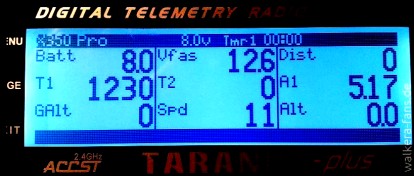
A new consept, you can have flight information sent from your model to your TX screen, height battery voltage, speed, GPS and many more.Flaps can be automatically lowered as flying speed is below certain speed, alarms can be set for low battery voltage
 |
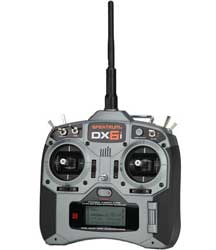 |
| Telemetry screen | Spectrum DX6i 2.4 ghz |